

For a hemisphere free from screwworm.
Credit: Arev Steffan

What is the New World Screwworm?
(Cochliomyia hominivorax)
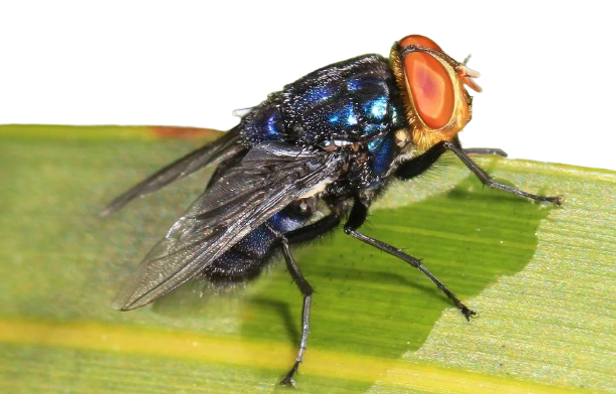
Credit: Judy Gallagher
Within 12-24 hours, eggs hatch into parasitic flesh-eating maggots that burrow into and feed on living tissue, causing immense suffering and - if left untreated - death.
Screwworms seek out large farmed animals, like cows, sheep, goats, but also domestic animals, like dogs. If left uncontrolled, they can cause billions in economic losses.
A fly that lays its eggs in wounds as small as a tick bite and body openings, like noses and eyes, of warm-blooded animals and humans.
Each female fly can lay up to 300 eggs at a time, and up to 3,000 over her lifespan.

Credit: Texas Animal Health Commission
The following images depict screwworm infection (myiasis) in animals. and people. Hover to reveal. Caution: these images may be distressing.

Deer infested with Screwworm

Dog infested with Screwworm

A man with more than 50 screwworm larvae removed from his face.

Why does screwworm control matter?
Credit: Helena Lopez
The opportunity in front of us
Screwworm was eradicated from North and Central America, but existing approaches stopped working. New tools and growing attention mean we can be more ambitious and protect more countries from screwworm.
1957–1966
The United States pioneers eradication
The Sterile Insect Technique is developed and deployed. The US is declared screwworm-free by 1966 - delivering $1B in annual economic benefits.
1972–2006
Partnerships with Mexico and Central America lead to regional eradication.
Country by country, screwworm is eradicated south through Central America. A barrier zone at Panama's Darién Gap holds the line between North and South America.
2023–2024
The Panama barrier breaks
Existing technology fails - and cases in Panama surge. By late 2024, screwworm has reinfested Central America, and moved into Mexico. The US suspends live cattle imports.
Today
South America remains endemic - and North America faces reinfestation. Novel technologies offer new pathways forward
Over 159,000 animal cases across Central America and Mexico as of March 2026. Across South America, screwworm has always been endemic - and the tools to change that may soon exist.

Our goal is a screwworm-free hemisphere. We focus on extending control efforts to endemic countries in South America, while building the inter-American partnerships that lasting change requires.
What we're doing for a healthier, safer hemisphere.
Accelerating scientific innovation for screwworm prevention and control
Generating the evidence decision-makers need to plan and scale control programs
Translating scientific evidence into public policy
Engaging governments, producers, multilateral organizations, and communities
Building political will for coordinated hemispheric action
Mobilizing investments in screwworm control